

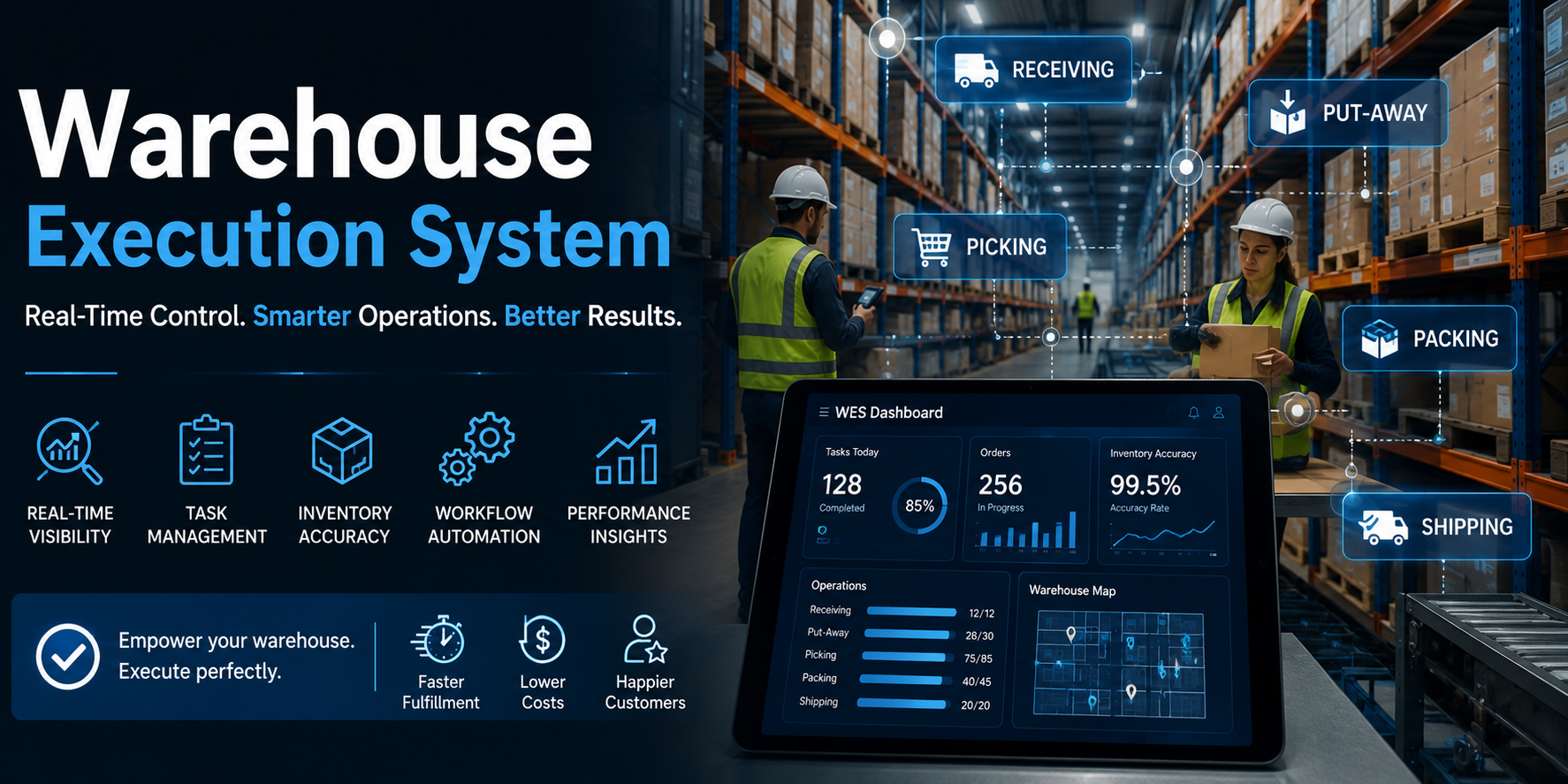
In today’s fast-moving supply chain, warehouses are expected to process orders faster, reduce errors, and adapt to changing customer demands. Traditional warehouse management approaches often struggle to keep pace with modern fulfillment requirements. This is where a Warehouse Execution System (WES) becomes a valuable solution.
A Warehouse Execution System bridges the gap between warehouse planning and execution by coordinating people, automation, inventory, and workflows in real time. Whether your business operates a manual warehouse or a highly automated distribution center, implementing a WES can significantly improve productivity, order accuracy, and operational efficiency.
This guide explains everything you need to know about Warehouse Execution Systems, including how they work, their benefits, integration with Warehouse Management Systems (WMS), and why they are becoming essential for modern supply chains.
What Is a Warehouse Execution System (WES)?
A Warehouse Execution System (WES) is software that manages and optimizes warehouse operations in real time. Unlike a Warehouse Management System (WMS), which primarily focuses on inventory management and warehouse planning, a WES actively controls daily execution by prioritizing tasks, balancing workloads, and coordinating warehouse resources.
The system continuously monitors warehouse activity and adjusts workflows based on current conditions, helping warehouses operate more efficiently.
A Warehouse Execution System commonly manages:
- Order prioritization
- Task scheduling
- Labor allocation
- Automated equipment coordination
- Inventory movement
- Picking optimization
- Packing workflows
- Shipping execution
How Does a Warehouse Execution System Work?
A Warehouse Execution System connects with multiple warehouse technologies and continuously processes operational data.
The typical workflow includes:
Receiving Inventory
Products enter the warehouse through receiving docks. The WES determines where inventory should be stored while minimizing travel distance.
Inventory Allocation
The system communicates with the Warehouse Management System to identify inventory locations and reserve stock for incoming orders.
Intelligent Task Assignment
Rather than assigning work manually, the WES automatically distributes tasks based on:
- Employee availability
- Equipment availability
- Order priority
- Warehouse congestion
- Shipping deadlines
Real-Time Picking
Workers or autonomous robots receive optimized picking instructions. The WES constantly updates routes as warehouse conditions change.
Packing and Verification
Orders are verified before shipping using barcode scanning or automated validation systems.
Shipping Coordination
The WES ensures completed orders are staged correctly and released according to carrier schedules.
Warehouse Execution System vs Warehouse Management System
Although both systems improve warehouse operations, they serve different purposes.
| Warehouse Management System (WMS) | Warehouse Execution System (WES) |
|---|---|
| Manages inventory | Executes warehouse activities |
| Focuses on planning | Focuses on real-time execution |
| Controls stock locations | Optimizes workflow continuously |
| Manages warehouse rules | Dynamically adjusts priorities |
| Supports inventory accuracy | Maximizes operational efficiency |
Many modern warehouses use both systems together.
Key Features of a Warehouse Execution System
Real-Time Task Management
A WES continuously evaluates warehouse conditions and assigns work where it is most needed.
Dynamic Order Prioritization
High-priority customer orders automatically move to the front of the processing queue without manual intervention.
Labor Optimization
Warehouse employees receive tasks based on their:
- Skills
- Current location
- Equipment certifications
- Workload
This reduces idle time while improving productivity.
Automation Control
Warehouse Execution Systems integrate with:
- Conveyor systems
- Autonomous Mobile Robots (AMRs)
- Automated Storage and Retrieval Systems (AS/RS)
- Robotic picking systems
- Sortation equipment
The WES synchronizes all automated processes with human workers.
Inventory Visibility
Managers gain real-time visibility into:
- Inventory levels
- Order status
- Equipment performance
- Employee productivity
- Shipping progress
Exception Management
If equipment fails or inventory becomes unavailable, the WES immediately reroutes work to minimize disruptions.
Benefits of a Warehouse Execution System
Faster Order Fulfillment
Optimized workflows reduce order processing times and increase shipping speed.
Higher Warehouse Productivity
Employees spend less time waiting for tasks and more time completing productive work.
Improved Order Accuracy
Barcode scanning and automated verification reduce picking and shipping errors.
Better Labor Utilization
Managers can optimize staffing levels without increasing labor costs.
Enhanced Automation Performance
Robots and automated systems operate more efficiently when coordinated by a Warehouse Execution System.
Lower Operating Costs
Improved workflow efficiency reduces:
- Overtime
- Labor expenses
- Shipping errors
- Inventory handling costs
Scalability
As businesses grow, a WES can manage increased order volumes without requiring significant operational changes.
WES Integration with Warehouse Management Systems
A Warehouse Execution System works alongside a Warehouse Management System rather than replacing it.
Typical integration includes:
Warehouse Management System Handles
- Inventory control
- Receiving
- Stock locations
- Purchase orders
- Returns
Warehouse Execution System Handles
- Order execution
- Picking optimization
- Labor management
- Automation coordination
- Workflow balancing
This combination creates a more efficient warehouse ecosystem.
Warehouse Execution System and Automation
Modern warehouses increasingly depend on automation.
A Warehouse Execution System integrates with technologies including:
- Autonomous Mobile Robots (AMRs)
- Automated Guided Vehicles (AGVs)
- Conveyor systems
- Robotic palletizers
- Automated sorters
- Voice picking systems
- RFID technology
- Barcode scanners
Instead of managing each system independently, the WES coordinates them all through one intelligent platform.
Industries That Benefit from Warehouse Execution Systems
Warehouse Execution Systems are widely used across multiple industries.
E-commerce
Supports same-day and next-day fulfillment while managing high order volumes.
Retail Distribution
Optimizes replenishment and seasonal inventory movement.
Manufacturing
Coordinates raw materials, production inventory, and finished goods.
Food and Beverage
Improves inventory rotation and expiration date management.
Pharmaceutical Warehouses
Supports regulatory compliance while maintaining product traceability.
Third-Party Logistics (3PL)
Manages multiple customers with varying fulfillment requirements.
Key Performance Indicators Improved by WES
Organizations commonly see improvements in:
- Order cycle time
- Picking accuracy
- Labor productivity
- Inventory accuracy
- Shipping accuracy
- Dock utilization
- Equipment efficiency
- Warehouse throughput
Real-time analytics help managers identify bottlenecks and continuously improve operations.
Challenges of Implementing a Warehouse Execution System
While the benefits are substantial, implementation requires careful planning.
Common challenges include:
- Integration with existing software
- Employee training
- Change management
- Initial implementation costs
- Data accuracy requirements
- Automation compatibility
Working with experienced implementation partners can help reduce deployment risks.
Future Trends in Warehouse Execution Systems
Warehouse technology continues to evolve rapidly.
Emerging trends include:
- Artificial Intelligence (AI)-driven task optimization
- Predictive analytics
- Digital twins for warehouse simulation
- Autonomous robot orchestration
- Machine learning for demand forecasting
- Cloud-based Warehouse Execution Systems
- Internet of Things (IoT) integration
- Real-time supply chain visibility
These innovations will enable warehouses to become more adaptive, efficient, and resilient.
Best Practices for Implementing a Warehouse Execution System
To maximize the value of a WES:
- Assess current warehouse workflows before implementation.
- Integrate the WES with your existing WMS, ERP, and automation platforms.
- Train employees thoroughly on new processes.
- Use real-time analytics to monitor performance.
- Review KPIs regularly and optimize workflows continuously.
- Plan for scalability as order volumes increase.
Conclusion
A Warehouse Execution System (WES) has become a critical technology for businesses seeking faster, smarter, and more efficient warehouse operations. By managing workflows in real time, coordinating labor and automation, and integrating seamlessly with Warehouse Management Systems, a WES helps reduce costs, improve order accuracy, and enhance customer satisfaction.
As supply chains become increasingly complex and customer expectations continue to rise, investing in a Warehouse Execution System can provide the agility and operational visibility needed to stay competitive. Whether you operate an e-commerce fulfillment center, manufacturing warehouse, retail distribution hub, or third-party logistics facility, a well-implemented WES can transform warehouse performance and support long-term business growth.