

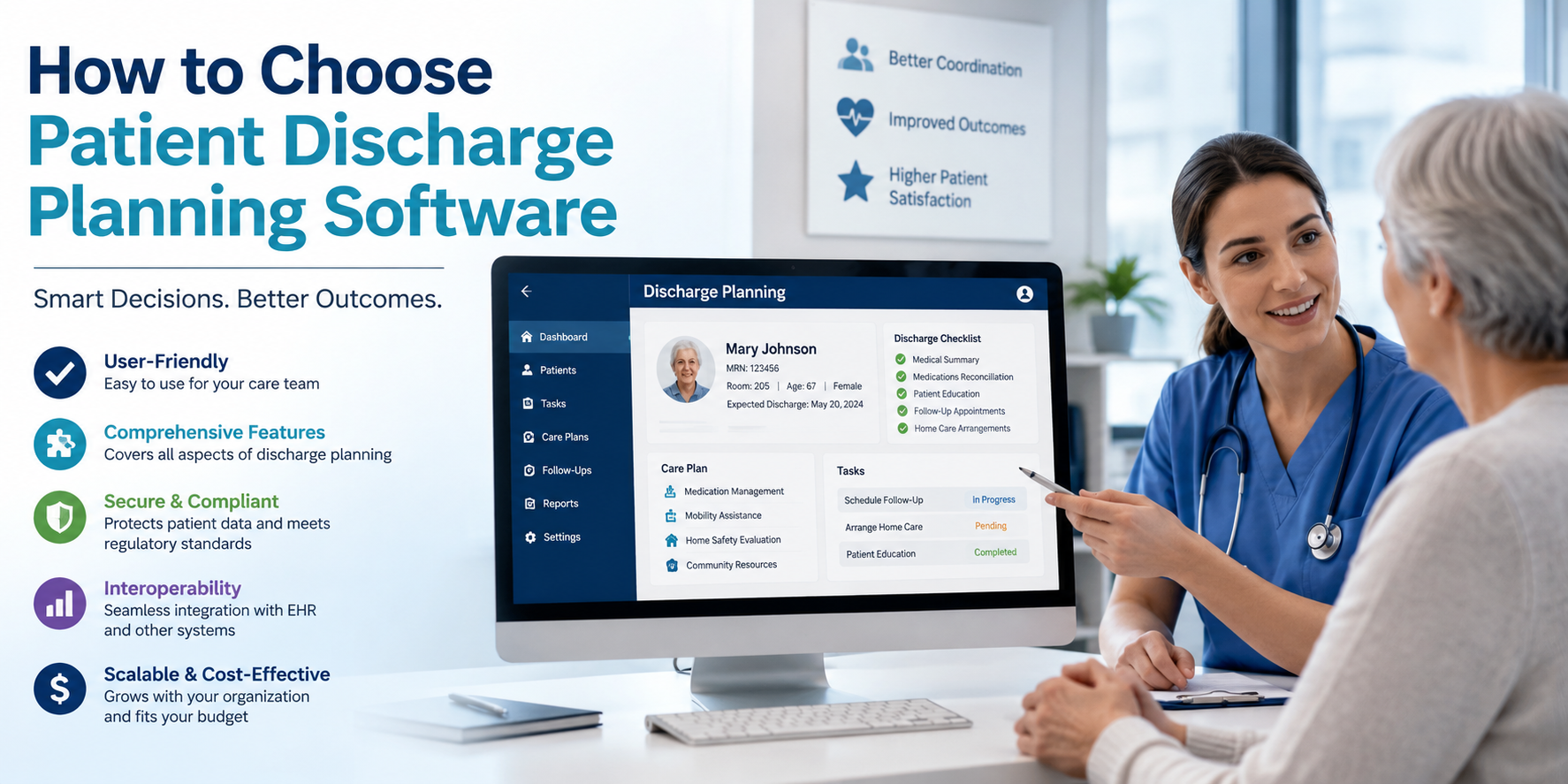
Introduction
Hospital discharge is one of the most important stages of a patient’s healthcare journey. A successful discharge requires clear communication between doctors, nurses, case managers, patients, families, and post-acute care providers. When this process is poorly coordinated, hospitals may experience delayed discharges, higher readmission rates, unnecessary costs, and lower patient satisfaction.
Modern patient discharge planning software helps healthcare organizations streamline these complex workflows by improving communication, organizing patient information, tracking discharge progress, and supporting care coordination across multiple providers. When integrated with discharge planning becomes more efficient by giving healthcare teams centralized access to patient records, treatment plans, and follow-up care information.
This guide explains how to choose the right patient discharge planning software, the features that matter most, and how the right solution can improve both operational efficiency and patient outcomes. If you’re looking to strengthen overall hospital workflows, you may also find our guide on Patient Management Software (PMS) helpful for understanding how digital healthcare systems support better patient care from admission through discharge.
What Is Patient Discharge Planning Software?
Patient discharge planning software is a digital solution designed to help hospitals and healthcare organizations manage the process of safely transitioning patients from hospital care to their next level of treatment.
Depending on the platform, the software may help healthcare teams:
- Coordinate discharge planning
- Manage referrals
- Track patient progress
- Document discharge activities
- Connect with rehabilitation centers
- Arrange home healthcare services
- Communicate with insurance providers
- Monitor discharge barriers
Rather than relying on spreadsheets, paper records, emails, or phone calls, hospitals can manage the entire discharge process from one centralized system
Why Hospitals Need Modern Discharge Planning Solutions
Healthcare systems are becoming increasingly complex.
Patients often require follow-up care from multiple providers after leaving the hospital. Delays in communication can slow recovery and increase the risk of readmission.
Modern discharge planning software helps hospitals:
- Reduce discharge delays
- Improve patient safety
- Increase staff productivity
- Improve bed availability
- Enhance patient satisfaction
- Reduce administrative work
- Improve communication between departments
These improvements benefit both healthcare providers and patients.
Key Features to Look for in Patient Discharge Planning Software
Not every platform offers the same capabilities. Before selecting a solution, healthcare organizations should evaluate which features best fit their workflows.
Important features include:
Care coordination
The software should allow multiple care teams to collaborate in real time throughout the discharge process.
Referral management
Hospitals should be able to send referrals electronically to rehabilitation centers, skilled nursing facilities, and home healthcare agencies.
Patient tracking
Case managers should easily monitor each patient’s discharge status and identify delays before they become serious problems.
Documentation
Good software automatically records discharge activities, reducing paperwork while supporting compliance.
Reporting
Analytics dashboards help administrators monitor discharge performance, identify bottlenecks, and improve operational efficiency.
Understanding the Difference Between Referral Management and Care Transition Coordination
These two functions are often confused.
Referral management focuses on sending patient information to post-acute care providers and receiving acceptance.
Care transition coordination is much broader.
It includes:
- Communication between providers
- Patient education
- Follow-up appointments
- Medication management
- Family involvement
- Ongoing monitoring after discharge
Hospitals should select software that supports their specific care model rather than assuming every platform offers complete transition management.
The Importance of Electronic Health Record (EHR) Integration
One of the most valuable features of discharge planning software is seamless integration with Electronic Health Record (EHR) systems.
Without integration, staff often duplicate work by manually entering patient information into multiple systems.
Integrated platforms automatically retrieve:
- Patient demographics
- Diagnoses
- Medications
- Laboratory results
- Clinical notes
- Insurance information
This saves time while reducing documentation errors.
Why HL7 and FHIR Compatibility Matter
Modern healthcare systems rely on standardized data exchange.
Software supporting HL7 and FHIR standards communicates more effectively with existing healthcare technology.
Benefits include:
- Faster data sharing
- Better interoperability
- Reduced manual entry
- Improved accuracy
- Easier implementation
Hospitals planning future technology upgrades should prioritize platforms built around these widely accepted standards.
Evaluating Workflow Efficiency for Case Managers and Social Workers
Case managers often handle dozens of patients simultaneously.
If software is difficult to use, productivity suffers.
Look for software that offers:
- Simple dashboards
- Automated reminders
- Easy referral tracking
- Minimal clicks
- Mobile accessibility
- Custom workflows
A user-friendly interface increases staff adoption and improves overall efficiency.
Choosing Software That Supports Faster and Safer Patient Discharges
Delayed discharges reduce hospital capacity and increase operational costs.
Effective discharge planning software identifies barriers early, including:
- Insurance authorization delays
- Transportation issues
- Equipment availability
- Home care arrangements
- Post-acute facility placement
Addressing these issues before discharge helps patients leave safely and on time.
Managing Post-Acute Care Referrals More Effectively
Many patients require ongoing treatment after hospitalization.
Discharge planning software helps hospitals coordinate referrals for:
- Skilled nursing facilities
- Rehabilitation centers
- Home health agencies
- Hospice services
- Long-term care providers
Electronic referrals improve communication while reducing paperwork.
Matching Patients with the Right Post-Acute Care Providers
Choosing the appropriate post-discharge provider is essential for recovery.
Modern software can help compare providers based on:
- Available services
- Bed availability
- Clinical specialties
- Geographic location
- Patient preferences
- Insurance compatibility
This helps healthcare teams make informed placement decisions.
Supporting Home Health, Rehabilitation, and Skilled Nursing Placements
Different patients require different levels of care after discharge.
The right software supports coordination across multiple care settings, making transitions smoother while reducing confusion for patients and families.
Improving Patient Safety and Reducing Hospital Readmissions
Poor discharge planning often contributes to avoidable readmissions.
Good software improves patient outcomes by ensuring:
- Medication instructions are complete
- Follow-up appointments are scheduled
- Care providers receive accurate information
- Patients understand discharge instructions
- Outstanding tasks are completed before discharge
These improvements lower readmission risk and enhance continuity of care.
Ensuring Compliance with Healthcare Regulations
Healthcare organizations must meet strict regulatory requirements.
Discharge planning software helps maintain compliance by creating standardized workflows and documenting every stage of the discharge process.
Automated documentation also simplifies audits and quality reporting.
Documentation, Reporting, and Audit Readiness
Accurate records protect both patients and healthcare organizations.
Modern software automatically captures:
- Time-stamped activities
- Staff actions
- Referral history
- Patient education records
- Care coordination notes
Detailed reporting helps hospitals evaluate performance while remaining audit-ready.
How Discharge Planning Software Enhances Patient Experience
Patients benefit when discharge planning is organized and transparent.
Improved coordination reduces confusion by ensuring patients receive:
- Clear discharge instructions
- Medication information
- Follow-up appointments
- Contact information
- Home care guidance
Better communication increases confidence during recovery.
Security, Privacy, and HIPAA Compliance Considerations
Healthcare organizations manage highly sensitive patient information.
When evaluating software, ensure it provides:
- Data encryption
- Role-based access controls
- Secure cloud storage
- Audit logs
- Multi-factor authentication
- HIPAA compliance
Strong security protects patient privacy while supporting regulatory requirements.
Cloud-Based vs. On-Premise Patient Discharge Planning Software
Cloud-based platforms offer:
- Faster deployment
- Automatic updates
- Remote access
- Lower hardware costs
- Better scalability
On-premise solutions may provide greater internal control but usually require larger IT investments and ongoing maintenance.
Healthcare organizations should choose the deployment model that best fits their infrastructure.
Customization and Scalability for Growing Healthcare Organizations
Every hospital operates differently.
The best software allows organizations to customize:
- Workflows
- Notifications
- Referral processes
- Reporting dashboards
- User permissions
Scalable platforms continue supporting hospitals as patient volumes and service lines expand.
Questions to Ask Before Selecting a Software Vendor
Before making a purchasing decision, ask vendors:
- Does the software integrate with our EHR?
- How long does implementation take?
- What training is provided?
- What customer support is available?
- How frequently are updates released?
- Is the platform scalable?
- What security certifications are maintained?
These questions help identify long-term partners rather than simply software providers.
Common Mistakes to Avoid When Choosing Discharge Planning Software
Organizations should avoid:
- Selecting software based solely on price
- Ignoring staff usability
- Overlooking integration capabilities
- Failing to involve case managers
- Underestimating implementation time
- Choosing unnecessary features
Careful planning leads to better long-term value
Best Practices for Successful Software Implementation
Successful implementation includes:
- Involving clinical staff early
- Providing comprehensive training
- Testing workflows before launch
- Monitoring performance metrics
- Gathering user feedback
- Continuously improving processes
Implementation should focus on people and workflows as much as technology.
Measuring Success After Implementation
Hospitals should monitor measurable outcomes such as:
- Reduced discharge delays
- Lower readmission rates
- Improved patient satisfaction
- Faster referral completion
- Increased staff productivity
- Better bed utilization
- Improved documentation quality
Tracking these metrics helps organizations maximize the software’s value.
Future Trends in Patient Discharge Planning Technology
Healthcare technology continues to evolve rapidly.
Emerging innovations include:
- Artificial intelligence for discharge prediction
- Predictive analytics for readmission prevention
- Automated care coordination
- Mobile patient engagement tools
- Real-time communication platforms
- Expanded interoperability across healthcare systems
These advancements will further improve patient transitions and healthcare efficiency.
Conclusion
Choosing the right patient discharge planning software is about more than purchasing technology—it’s about improving how patients transition from hospital to home or another care setting. The best solution supports healthcare teams with streamlined workflows, seamless communication, secure data management, and integration with existing clinical systems.
By carefully evaluating features such as EHR integration, referral management, interoperability, usability, compliance, and scalability, hospitals can invest in software that enhances care coordination, reduces readmissions, improves operational efficiency, and delivers better patient outcomes. As healthcare continues to evolve, selecting a flexible and future-ready discharge planning platform will help organizations provide safer, more connected, and more patient-centered care.
Frequently Asked Questions (FAQs)
What is patient discharge planning software?
It is software that helps healthcare providers coordinate patient discharges, manage referrals, document care transitions, and improve communication between hospitals and post-acute care providers.
How does discharge planning software improve patient outcomes?
It streamlines care coordination, reduces discharge delays, ensures accurate communication, and supports better follow-up care, which can lower hospital readmission rates.
What features should hospitals look for in discharge planning software?
Key features include EHR integration, referral management, workflow automation, patient tracking, reporting tools, compliance support, secure data handling, and user-friendly interfaces.
Can discharge planning software integrate with existing EHR systems?
Yes. Many modern platforms integrate with major EHR systems using standards such as HL7 and FHIR, reducing duplicate data entry and improving workflow efficiency.
Is discharge planning software suitable for both small hospitals and large health systems?
Yes. Many solutions are scalable and can be customized to meet the needs of community hospitals, specialty clinics, and large healthcare networks.
How does discharge planning software help reduce hospital readmissions?
By improving discharge coordination, ensuring proper follow-up care, facilitating communication with post-acute providers, and helping patients understand their care plans, the software supports safer transitions and reduces the likelihood of preventable readmissions.